
Posts have appeared on social media suggesting that Switzerland is ending the so-called “Swiss holidays” and plans to send Ukrainians from several western regions back to their home country. According to these posts, such individuals “will no longer receive refugee status and must return to where they came from.”
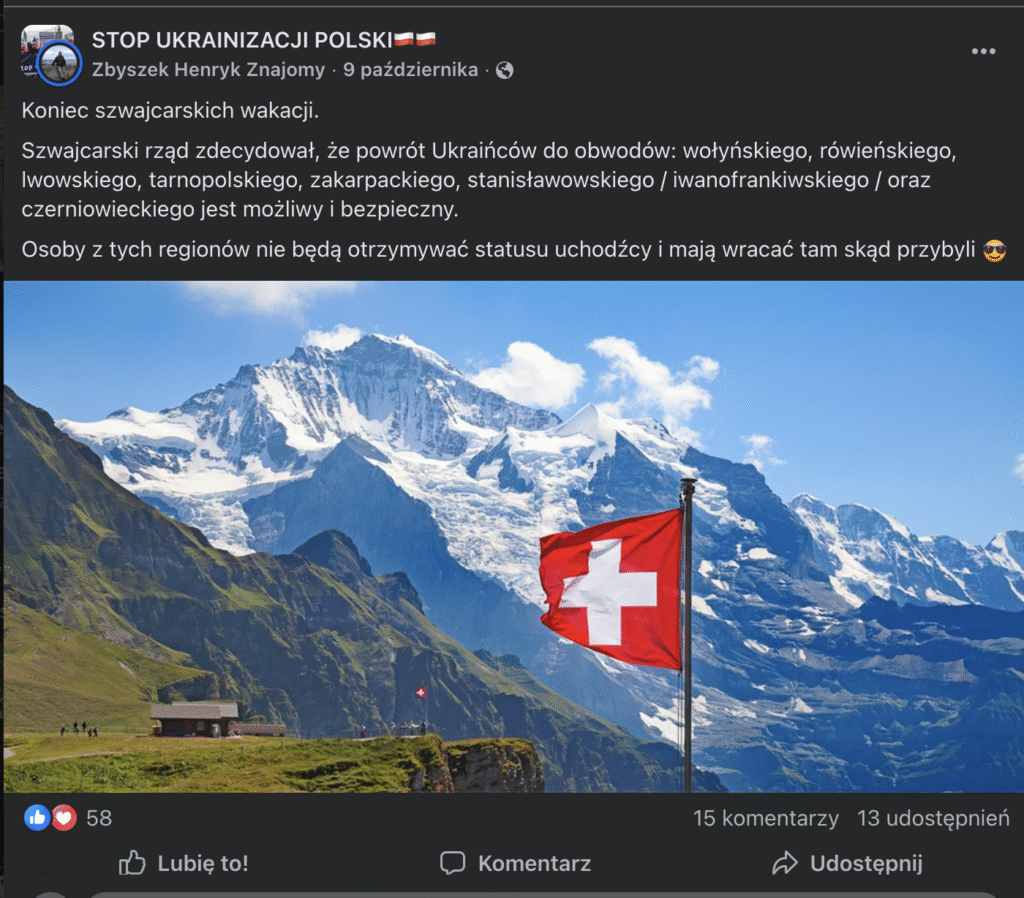
These posts quickly gained traction, especially in anti-Ukrainian groups. We examine what the Swiss government has actually decided.
Summary of the analysis
- Starting 1 November 2025, Switzerland will introduce new rules for granting Status S (a form of protection for refugees from Ukraine).
- The government has designated several western Ukrainian regions as areas where return may be possible and safe.
- The change applies only to new applications for Status S (people who currently hold it will not lose it at least until March 2027).
- Contrary to viral posts, there is no decision on mass deportations, and each case will be reviewed individually.
- If Status S is denied, it is still possible to apply for asylum or receive temporary admission if return would be too dangerous.
What does the viral post claim?
The post states that the Swiss government:
- has recognized that returning Ukrainians to western oblasts is “possible and safe”
- will no longer grant refugee status to people from these regions
- these individuals “must return to where they came from”
What has the Swiss government actually announced?
The matter is clarified in official documents and communications from the State Secretariat for Migration (SEM).
The Swiss government and parliament have concluded that under the current security conditions, there is no basis to automatically grant protection to all Ukrainians—only to those from regions where staying or returning home is genuinely dangerous.
According to SEM, starting 1 November 2025, applications for protection status S will be assessed based on the applicant’s last place of residence in Ukraine. This means that Switzerland will begin differentiating Ukrainian regions by safety level.
Which regions have been deemed safer?
- Volyn
- Rivne
- Lviv
- Ternopil
- Zakarpattia
- Ivano-Frankivsk
- Chernivtsi
These are exactly the same regions mentioned in the viral post.
Who is affected by the new rules?
Contrary to what the post suggests—not all Ukrainians in Switzerland.
The new rules apply only to new applications for Status S.
SEM emphasizes that individuals who already hold Status S will not lose it simply because they come from these regions.
If an application is rejected due to the region of origin, a removal order may be issued. However, if returning to Ukraine is impossible or dangerous in a specific case, temporary admission may be granted. This means no forced return if a person has a serious personal, medical, family, or legal situation that makes return unsafe.
Why is Switzerland introducing these changes?
In 2024, the Swiss parliament adopted a motion by MP Esther Friedli to differentiate Ukrainian regions when evaluating applications for Status S.
The government explains that the goal is to focus protection on individuals who truly come from areas affected by fighting or occupation.
Conclusion: the viral graphic is a mix of facts and manipulation
The post is based on real information: Switzerland is introducing new rules for Status S and has designated some regions as safer. However, its presentation removes context, suggests mass deportations, triggers emotions, and exaggerates the scope of the changes.
For these reasons, the post qualifies as disinformation based on true facts but presented in a simplified and misleading way.