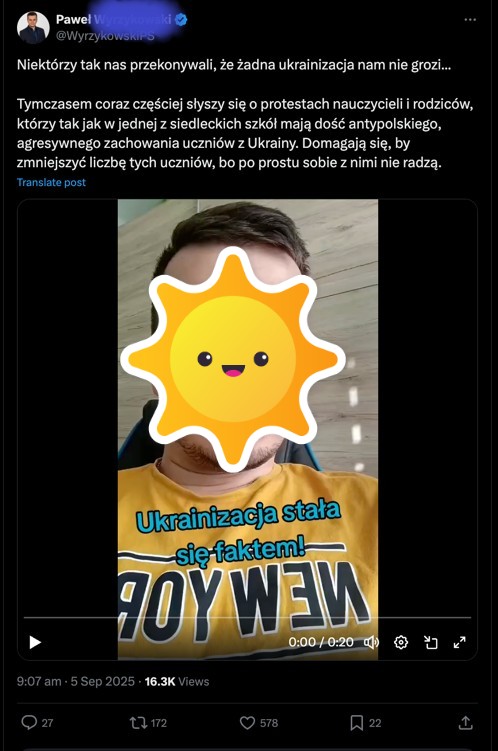
A post appeared on Facebook profile in which the author states:
“Some people kept convincing us that no Ukrainization threatens us… Meanwhile, we hear more and more about protests from teachers and parents who (…) demand reducing the number of those students (Ukrainians), because they simply cannot cope with them.”
He also gives an example of one school where, according to reports:
“In the class of my acquaintance’s child, there are only two Polish kids, and the rest are Ukrainians — it turns out this is the new standard. I wonder whether these Ukrainian children will be Polonized, or whether Polish children will be Ukrainized?”
Short analysis
• Online posts have suggested that the presence of students from Ukraine in Polish schools may lead to “Ukrainization” in the sense of linguistic and cultural dominance.
• However, an analysis of the data shows that such claims are mostly based on isolated cases and do not reflect the nationwide situation.
Facts and data
Scale of the influx of students from Ukraine
According to a report by the Center for Civic Education (CEO) and the IRC, across the entire education system (kindergartens, schools, adult schools), foreign students constitute 5.3% of all learners, which amounts to approx. 353,000 people, of whom 295,500 are Ukrainians.
Moreover, only 67% of schools have any foreign students enrolled.
Source: https://ceo.org.pl/uczniowie-cudzoziemcy-w-polskich-szkolach-w-roku-szkolnym-2024-2025-nowy-raport-ceo-i-irc/
Example: Primary School No. 1 in Siedlce
Media reported that in some classes of this school “half of the students are Ukrainian children.”
Source: https://tygodniksiedlecki.com/artykul/siedlce-rodzice-chca-n1627844
In reality, the school currently has 65 students from Ukraine, which is about one-seventh of the total student population.
Source: same as above.
The reason for a high share of students from Ukraine in certain classes lies in territorial distribution — students are assigned to schools based on where they live.
In the case of Siedlce, a residence center for Ukrainian refugees is located near the school, which explains the local concentration of Ukrainian students.
Source: https://www.rdc.pl/aktualnosci/siedlce/szkola-podstawowa-nr-1-w-siedlcach-ukraincy-w-klasach-petycja-rady-rodzicow_LA6iA3O8Tq2O2IjZvLUD
Can we speak of “Ukrainization” in the sense of linguistic or cultural dominance?
The data shows that the presence of Ukrainian students in Polish schools is significant and permanent — a CEO/UNICEF report notes that Polish schools have become “multicultural and will remain so.”
Source: https://ceo.org.pl/wp-content/uploads/2024/10/Ukrainscy-uczniowie-w-polskiej-szkole_raport-CEO_UNICEF_PL.pdf
However, claims such as “only two Polish children in a class, the rest Ukrainian” as a new nationwide standard must be assessed in a broader context.
The data clearly shows that although in some schools there are classes where Ukrainian students make up a large portion, this is not a widespread phenomenon across Polish education.
Integration and student behavior
Reports about conflicts or allegedly aggressive behavior by Ukrainian students are usually isolated incidents.
Studies by CEO/UNICEF emphasize that the integration process is ongoing, and many schools actively support students dealing with migration experiences.
Source: https://ceo.org.pl/wp-content/uploads/2024/10/Ukrainscy-uczniowie-w-polskiej-szkole_raport-CEO_UNICEF_PL.pdf
Conclusion
The presence of Ukrainian students in Polish schools is noticeable and long-term, contributing to greater cultural diversity in educational institutions.
Although language barriers can create difficulties, these challenges concern mainly individual classes and require systemic support, not limiting the admission of new students.
Claims about widespread “Ukrainization” of Polish schools — meaning alleged linguistic or cultural dominance — are not supported on a national level.
The examples cited in the media, such as in the post, pertain to individual schools and do not reflect the overall educational situation in Poland.